
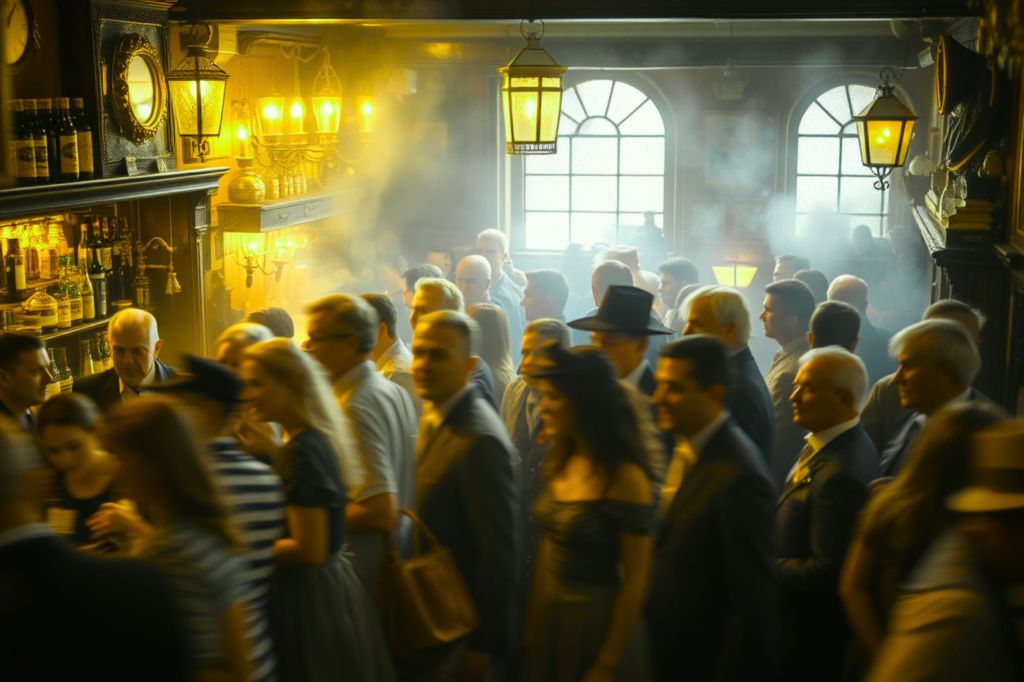
The night I discovered every pub in England was the same pub, I was nursing my third pint of bitter and watching Margaret Whitmore fade away one memory at a time—though I didn’t yet understand I was fading too.
She’d been coming here since 1953, she told me between sips of her usual gin and tonic, though the barman, a weathered Yorkshireman called Derek, insisted she’d only started last Tuesday. The brass nameplate on her stool still read Reserved for Mrs. M. Whitmore, but when I asked who put it there, Derek just polished a glass and hummed Jerusalem like a hymn he’d long stopped believing.
“Thing is, love,” Margaret said, her Cotswold vowels curling like pipe smoke, “I can remember every word I’ve ever said in this place. Every time Tommy Henderson asked the barmaid if she fancied a dance. But I can’t remember how to boil an egg. Or if I’ve still got a cat. That’s odd, isn’t it?”
The Quantum Arms sat at the corner of Pemberton Street and nowhere, a Victorian gin palace built on memory and mould. Its stained-glass windows were etched with hop vines and half-forgotten faces. Ales on tap included Second Chances, Regret Mild, and Crossroads Bitter. The mirrors—clouded with the residue of centuries—reflected only the living. Or maybe only the dead.
I’d stumbled in after missing the last train to Birmingham, phone dead, wallet lighter than it should’ve been. Derek handed me a pint before I spoke.
“You look like a bitter man,” he said, with a wink that might’ve belonged to an uncle or an angel.
I offered him a twenty.
“Money’s no good here after nine,” he said, eyes flicking to something I couldn’t see. “The dying pay with different coin entirely.”
That should’ve been my first warning.
Margaret was telling me about her husband Albert, when the young soldier walked in. Eighteen, maybe. Dark hair, nervous hands. He wore a 1952 uniform like it was still warm from the parade ground. Ordered a half of mild and kept glancing at the empty stool beside Margaret, like he was waiting for someone he’d never meet again.
“He always does that,” Margaret whispered. “Every night. Though some nights he turns up first and waits for me. It’s like time’s a bit wobbly here.”
“How long have you been coming?” I asked.
She considered this like I’d asked her to describe colour to someone born blind. “Since Albert died. Or before. Derek keeps track.”
Derek—who looked old enough to have served drinks to Dickens and young enough to have pulled pints through both wars—caught my eye. He tilted his head toward the back room. “Bit of quiet, if you fancy it.”
The back room shouldn’t have fitted behind the bar. It stretched sideways, warped like a fisheye lens. The walls were lined with sepia photographs that moved when you weren’t looking: a Victorian mill worker laughing with a plague doctor, a Spitfire pilot raising a glass with a miner in a flat cap, a punk in Doc Martens drinking with a medieval monk.
Derek poured himself a whisky—the only drink I ever saw him take.
“She’s dying,” he said. “Margaret. Been three weeks now. Ward 7, Bed 12. St. Bart’s.”
“But she’s here.”
He nodded. “So’s young Tommy. And Mrs. Pemberton from the corner shop passed in ’89. The Quantum Arms doesn’t serve the living. Not after nine.”
My skin prickled.
“But I’m not—”
“Motorbike. M40. Rain. Lorry didn’t see you. I’d reckon about an hour ago.”
The world tilted.
“I don’t feel dead.”
“They never do. Death’s not a switch, lad. It’s a pub crawl. The further you get, the less you recognise your own pint.”
I looked through the doorway. Margaret’s outline shimmered now, like heat haze. Tommy was smiling, raising a glass to someone I couldn’t see. The pub was full, but none of them cast shadows. I could see the sadness in Tommy’s eyes, even as he laughed. The girl he waited for must’ve never come through that door.
“What is this place?” I asked.
Derek gave a small, weary smile. “Same place it’s always been. The Dog and Duck in Sheffield. The Crooked House in Dudley. The Red Lion in Penzance. Different faces. Same taps. Same truths. A sort of halfway house with bitter on draught.”
“Why a pub?”
“Because we don’t dream of churches, lad. We dream of places where we told stories. Laughed. Regretted. Pubs hold more ghosts than graveyards.”
“You speak like someone who’s been here a long time.”
“Aye. Died in ’43. Blitz hit the old Prince of Wales in Bethnal Green. I was a landlord. Got everyone out but me. When the smoke cleared, I woke up behind the bar, still pulling pints.”
“You chose to stay.”
He nodded. “Someone had to run the place. It’s not limbo. It’s a waiting room. And every waiting room needs someone to bring the tea and biscuits.”
I let that sit.
“How long do I have?”
“Depends. What did you come to say?”
Emma. Still angry, probably. My mother—hurt by silence. My brother. Too many swallowed words. Too many bridges rotted by neglect.
“I need to make some calls.”
Derek slid over a black Bakelite phone. “Line’s always open.”
Emma answered on the third ring. Her voice cracked: “James? The police—”
“I’m in a pub,” I said, and I nearly laughed at how stupid it sounded.
She was crying. I told her the things I never could when it mattered. That the fights weren’t her fault. That I was scared. That I loved her. She told me to come home.
“I will,” I said, and we both knew I wouldn’t.
Next, I called my mum. Then my brother. Then others—colleagues I’d slighted, friends I’d drifted from. With each ring, a weight lifted. Like peeling off layers I didn’t know were crushing me.
One last call. A voicemail to my dad. Ten years too late. “I wish we’d had one more pint, old man. I wish I’d said I forgave you. Maybe I do now.”
I returned to the bar. Margaret was gone. Her stool sat empty, the brass plate now reading simply Reserved. Tommy was dancing with a girl in a poodle skirt, flickering like candlelight. She must’ve arrived while I was on the phone. He looked so young—so alive.
Near the door, a confused man in overalls had just entered, dripping rain and oil.
“Last orders,” Derek called, though his voice was softer than before, like he was growing further away.
I looked down. My hands were translucent. The bar beneath them felt more real than I did.
“What happens now?”
“Now you go,” Derek said. “Wherever you’re meant to. And you’ve earned it.”
“And you?”
He looked at the whisky. “I’ll be here a while longer. There’s always another lad with a wet coat and too much on his chest. But I remember everyone. You’ll fade, but I’ll raise a glass for you.”
“Thank you,” I said.
“You paid your tab,” he replied. “Even left a tip.”
The pub shimmered. The lights softened into stars. Voices faded to echoes. I felt myself loosening, like untying a knot that had held for years.
As I faded, I realised something Derek hadn’t said.
The Quantum Arms weren’t just for the dying.
It was for the living, too—the ones left behind, holding phones that had gone quiet. The ones who needed a place to hear the words we finally remembered how to say. Every pub is the same pub because every goodbye is the same goodbye. A place for last chances, late confessions, and unfinished stories told over one final pint.
Somewhere in Birmingham, Emma was staring at a silent receiver. Somewhere in the Cotswolds, Margaret’s son was reading racing results to an empty bed. Somewhere near Leeds, a pub called The Fox and Firkin had a brass plate that just read Reserved.
And somewhere between life and whatever comes after, the Quantum Arms kept its doors open.
Time, gentlemen, please.
 Andromeda Magazine
Leave a comment