
It did not bother Malgretout that people made jokes behind his back about his field of research. He was Professor of Animal Behavior at Centerville University. He specialized in Cuteness, more specifically Mammalian Cuteness.
Many thought it weird to study cuteness, but actually the word ‘cuteness’ had started to gain national attention. He had already signed a contract with a pet food manufacturer, a publisher of glossy calendars, and he was becoming popular on television as a pet consultant. Every day he felt his colleagues’ envy.
In conjunction with the US National Park Service, he was developing a programme called, ‘Wild Animals Are Not Cute.’ The aim of this was to cut down on the number of people killed or injured each year trying to approach wild animals like bison, elk and baby bears.
Six postgraduate student assistants were working under Professor Malgretout’s direction. They strongly disliked him. He gave the same two or three students all the drudge work. He picked on certain students.
Their inside joke was that Malgretout was studying cuteness
precisely because he himself lacked that attribute. He had an unattractive rasping voice, a one-sided smile that was more of a one-sided grimace, and hooded eyes. He had mastered the fine art of belittling people with a few choice words.
Most people have a similar subjective judgement of cuteness. For example, dogs with long furry hair, floppy ears, and wagging tails are usually seen as cute. However, if they get too large, they may be perceived as being dangerous. Hairless dogs and cats are generally not seen as being cute, and dogs that walk around with their anuses exposed disgust a lot of people.
Malgretout was working to develop a Cuteness Index. This would have commercial applications in pet food marketing, dog shows, dog breeding, petting zoos, and the like.
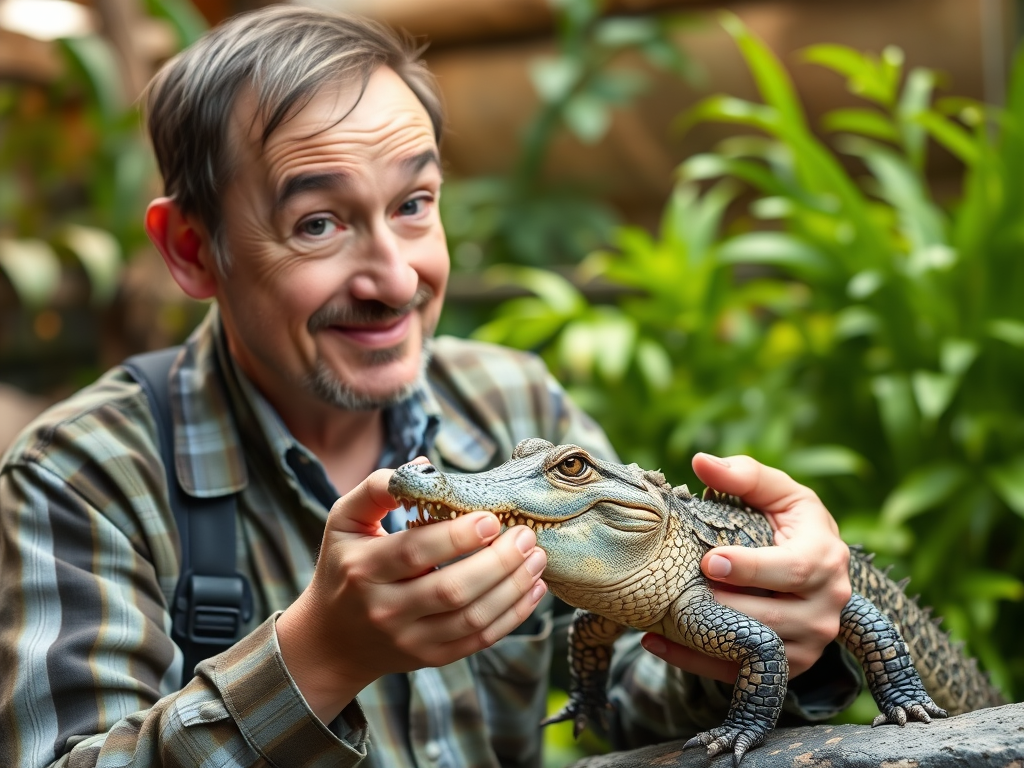
One day, a famous company which used a crocodile logo in its advertising approached the Professor, asking him to lend his expertise in an advertising campaign. They wanted to film the Professor interacting with a baby crocodile to show how cute crocodiles were. The offer intrigued Malgretout. In fact, from childhood, he had been interested in why and when do baby crocodiles and alligators change from being viewed as sweet and cute, to being fearsome and dangerous. (Malgretout had been brought up in Florida.)
The enumeration offered was very generous. Furthermore, an advertising campaign would put his name and his work in front of an even wider public, as well as elevate his position within the University. Admittedly there was a small risk in handling crocodiles, but Malgretout believed he could manage that.
Centerville Zoo was famous for its well-appointed Reptile House, just a few minutes away from the University by car.
Malgretout wanted to make an impression on the fashion company and on the zoo, so he insisted the whole group of students accompany him to the Reptile House. Here he enjoyed bossing them around and showing how important he was.
Crocodiles are generally more aggressive than alligators, so alligators were the wiser choice for filming. However, Malgretout insisted that any lack of zoological accuracy would damage his reputation and lay him open to criticism. The project continued with crocodiles.
The advertising people had brought a collection of stuffed animal crocodiles in various sizes. These were used in rehearsals in order to practise the actions, movements, and poses which would be used with the real crocodiles, and the camera angles, lighting, and distances.
After these had been settled to general satisfaction, a period of orientation and practice for the actual crocodiles and photographers followed. Finally, two baby crocodiles of the same age and size, about eighteen inches long, were selected as possible candidates for the film shoot. Fred was deemed more photogenic than Henry and had a calmer personality. Consequently, he was chosen. (Henry had a lopsided mouth because his teeth were irregular, and he tended to be excitable and unpredictable in his behaviour.)
There was considerable discussion as to whether Malgretout should wear safari-type gear or simple casual everyday clothes. The latter were chosen since the aim was to portray crocodiles, in accordance with the advertising campaign, as cute.
The fact that this directly contradicted his work with the US National Park Service seemed to bother only his students, who attempted to point this out but were rudely ignored by Malgretout. His ambition ruled his judgement.
Finally, it was time to shoot. Malgretout and the crocodile took their places in a watery jungle kind of setting. He prepared himself to demonstrate the cuteness of crocodiles.
He picked up the crocodile. Perhaps it was something to do with the noises of the filming or the movements of people, but no sooner had the filming started than the crocodile lunged at the Professor, and his right arm halfway up to his elbow disappeared into the crocodile. Everyone sprang into action. The jaws of the crocodile were prised apart and the animal rudely flung into the water. Presumably to be dealt with later.
The resident vet and an ambulance were called. After things had settled down a bit and they were waiting for the arrival of assistance, the student who had been nearest to this grisly scene discreetly beckoned to a couple of other students, gestured with her eyes to the very serious wound on the Professor’s arm, and then tapped her lower teeth on the left side of her mouth.
It was clear, by looking at the wound, that no puncture had been made by the fourth tooth from the front of the crocodile’s lower left jaw. The deep indentations on the skin of the arm from the other teeth were quite clear, but not from this fourth tooth.
The crocodile was Henry, and he was not photogenic precisely because of his irregular dentition.
Someone had switched crocodiles. By unspoken agreement, it seemed best not to pursue the matter further.
As Malgretout was taken away on a stretcher he was conscious enough to not reflect on his behaviour.
 Andromeda Magazine
Leave a comment